Integrating a storage solution with Lightico allows you to securely store completed documents from collaboration sessions in an external vault, along with key metadata from the session. Storage integrations support compliance, auditability, and long-term document retention, while keeping documents accessible to downstream systems and business processes.
The eOriginal integration builds on these standard capabilities by allowing you to map both predefined and custom metadata from Lightico to your eOriginal vault. In addition to automatically storing documents at the end of a session, you can define how Attributes and system values are passed to eOriginal, ensuring each vaulted document is fully contextualized, traceable, and aligned with your eOriginal transaction model.
Configure the integration
To configure the eOriginal integration:
If you have not already done so, open an account with eOriginal.
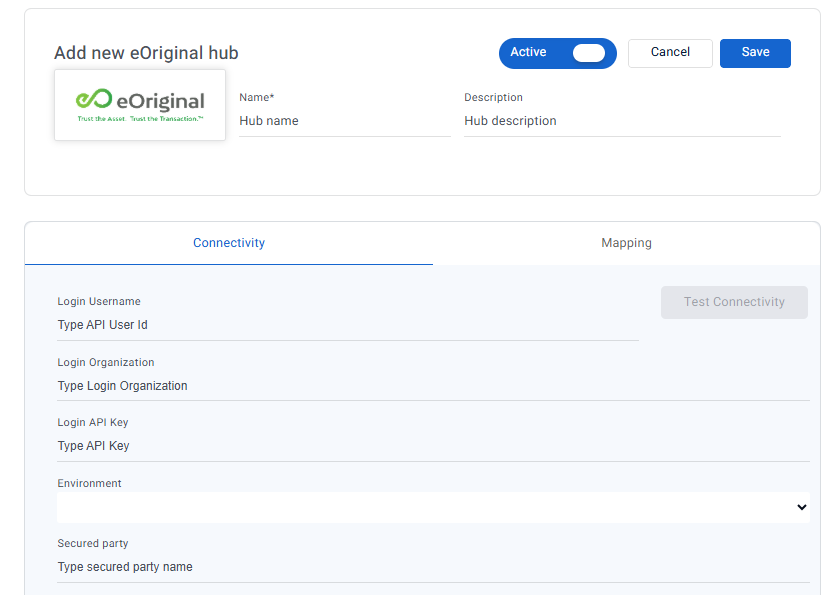
From Admin Center, go to Integrations and click the eOriginal hub.
Enter a Name and Description (optional) for the hub.
In the Connectivity tab, enter the following information that was provided by eOriginal after opening your account with them: Login Username, Login Organization, Login API Key
Select one of the eOriginal environment types: Preview, Test, OnDemand.
Enter the name of the party that is securing the document.
At the top of the integration hub window, click Save.
Mapping document information between Lightico and eOriginal
The integration hub enables you to define metadata that is sent when your document is stored. This data will be available together with the document in your eOriginal vault.
You can map two types of data:
Standard data
Standard data are properties that are defined by eOriginal. These properties are always added to a stored document. Of the standard data categories, some are dynamic, they change from document to document, and some are static, they are defined once and are the same for all transactions.
Dynamic
Select an Attribute or system value (where relevant) for each of the following:
eOriginal Property | Suggested Attribute Name | Default value (if Attribute is not mapped) | Note |
Transaction Name | transaction_name | Lightico session ID | Map an Attribute or system value |
Application ID | application_id | Lightico file ID | Map an Attribute or system value |
eOriginal ID | eoriginal_id | generated by eOriginal | Map an Attribute |
eOriginal Document ID | eoriginal_document_id | generated by eOriginal | Map an Attribute |
To map dynamic data from Lightico to eOriginal:
For each of the eOriginal properties, select Attribute or system value (where relevant).
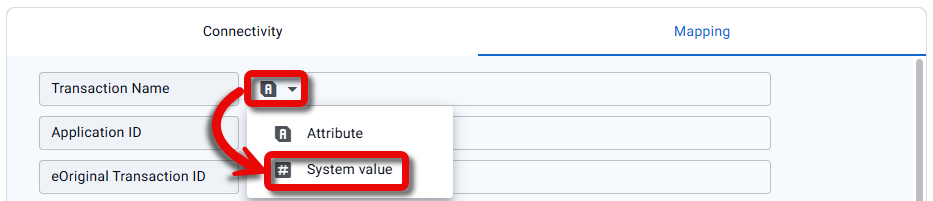
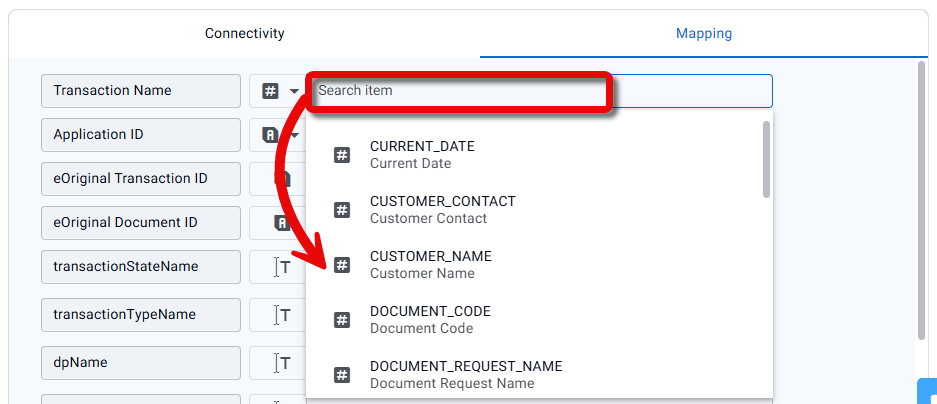
Click into the field and select the desired Attribute or system value.
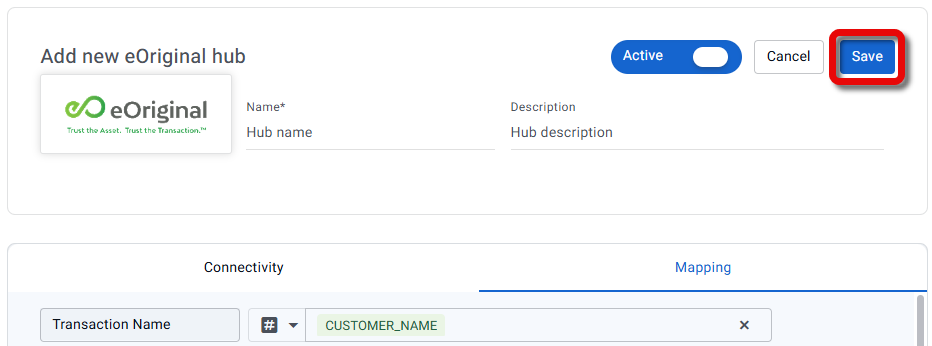
When you are finished defining all properties, click Save at the top of the page.
Static data
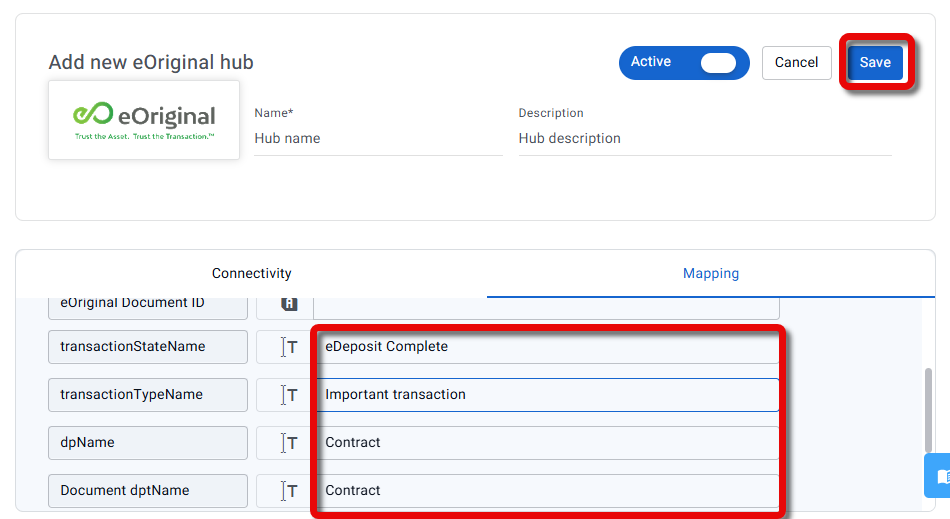
Define a text string for each of the following:
eOriginal Property | Default value |
AuditDpt Name | eDeposit Complete |
transactionStateName | Lightico |
transactionTypeName | Contract |
dptName | Contract |
Document dptName | Audit Log |
To map standard data between Lightico and eOriginal:
Enter a text string in each property field that you want to define.
When you are finished defining all properties, click Save at the top of the page.
Custom data
Custom data are properties that you can create and send to eOriginal to be stored with your documents. The name of the custom property is defined by you and the value is drawn from an Attribute or system value of your choice.
To create a custom data property:
Click Add custom field.
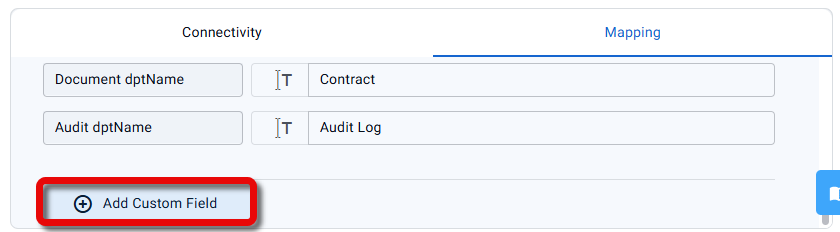
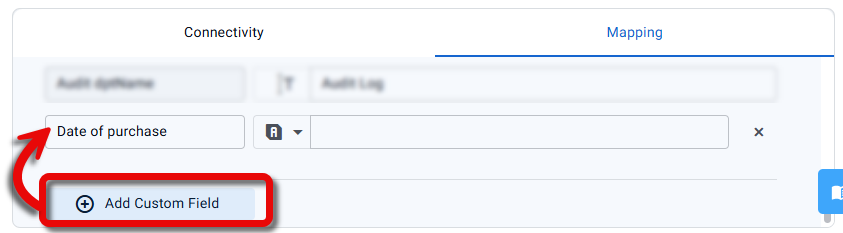
A new property appears.Enter a text string for the Key.
For the value, select Attribute or system value.
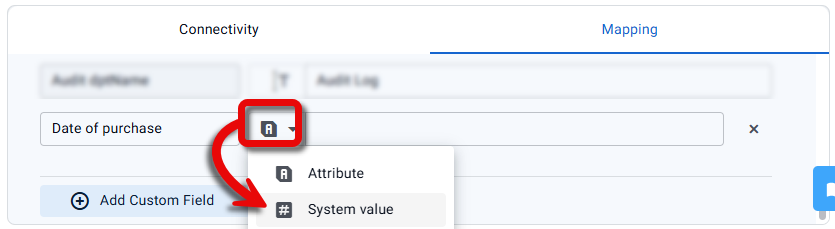
Click into the value field and select the desired Attribute system value.
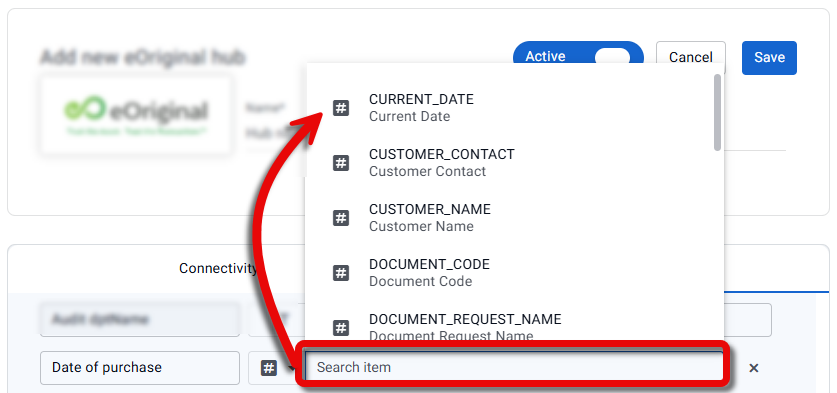
When you are finished defining all properties, click Save at the top of the page.
