Send a Workflow that requires agent input

Prev Next

When you send a Workflow that requires your input as an agent, a pop-up dialog box appears before the Workflow is added to the session, enabling you to provide the input. 

Types of input that may be required are:

A Workflow may require more than one type of input. For example, a Workflow may require you to provide your signature and to fill out a Form. See the sections below for more information about each of the types of input.

To send a Workflow that requires agent input:

  1. Add the desired Workflow to the session.

    A pop-up appears. 

  2. Provide any information required in the pop-up.

  3. Click Send.


Providing signature or initials

When you send a Workflow with one or more eSign documents that require an agent's signature or initials, a pop-up appears that requires you, the agent, to draw or type your signature.

You may be required to sign before or after the customer and additional participants. You’ll be given an opportunity to review each of the documents in the Workflow before applying your signature. You can draw or type your signature once and apply the same signature and/or initials to each of the eSign documents in the Workflow that require it.


Filling in a form

When you, as the agent, send a Workflow that includes an agent form, a pop-up appears that enables you to fill in the fields. The data you provide may be used later on in the Workflow. For example, if you provide a date of purchase in the form, and the date of purchase is required in a document in this Workflow, this field is automatically populated with the data you provided.


Uploading External Documents

As an agent, you can send a Workflow that includes one or more External Documents—documents that you upload at the time of the session. Unlike documents configured in advance by the Business Configurator, External Documents allow you to include the most up-to-date version and choose the exact file for each session.

When you add a Workflow that includes an External Document step, an upload dialog appears listing all required documents. For each document, the following identifying information is displayed:

  • Document name

  • Short description (optional) to help you understand what needs to be uploaded and locate the correct file

Once uploaded, documents are automatically placed in the correct position within the Workflow.

To upload an External Document to a Workflow: 

  1. Add the Workflow to the session.

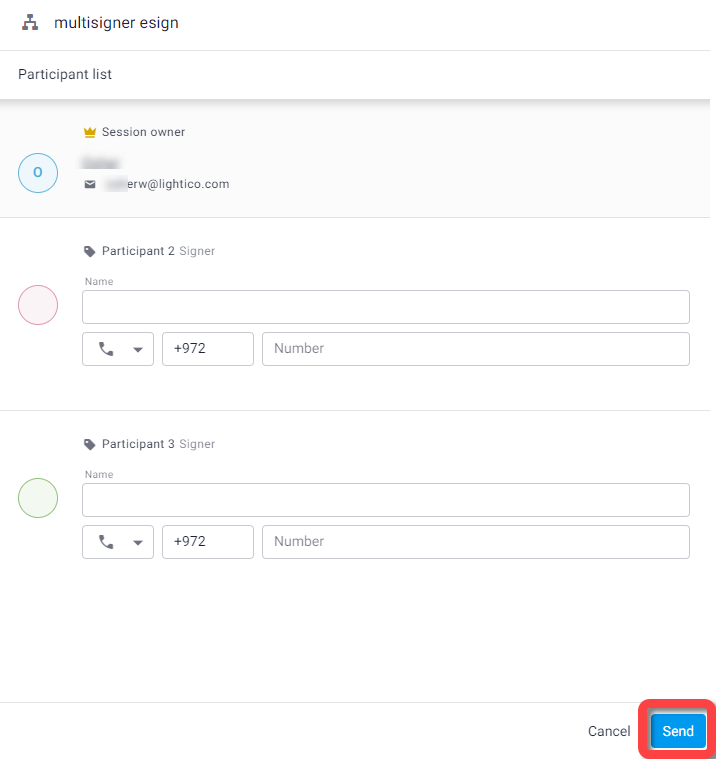
    If the document includes multiple participants, a Participant list dialog appears.

  2. Enter contact information for each participant and click Next.


  3. In the External Document pop-up, click Upload file.


  4. Select the file from your device.

    The file preview opens in the editor preview, where you can define how participants interact with the document by adding fields:

    1. At the top of the page, click the agent icon or one of the participant icons (A). This defines who is required to fill in the field. Fields are color-coded to match the participant icon.

    2. Click the type of field in the right toolbar (B).
      For more information about adding fields, see below.

    3. Click and drag fields in the desired locations on the document (C).

  5. Click Done.


    The document is added to the Workflow.

Adding fields to the document

After uploading a document, the editor preview allows you to add fields that define how participants interact with the document.

Supported field types:

  • Signature, initials, signature date, corporate stamp — For each participant configured as a Signer (by the Business Configurator), at least one of these fields must be added to the document.

  • Free text — Select the Agent participant to insert additional text into the document.

Note:

  • Participants assigned Approver or Viewer roles are not required to sign. Signature-related field options are disabled for these roles.

  • Participants assigned the Viewer role can open and view the document, but are not required to take any action and do not affect Workflow progress. This is useful when additional stakeholders need visibility into the document without participating in signing or approval.

External document preview with customer information fields

When you upload an External Document, the preview may display customer information fields that cannot be edited.

These fields behave as follows:

  • Some fields are prepopulated with existing customer or session data

  • Other fields are completed later when the agent or customer fills out related forms in the Workflow

These fields are shown in the preview for reference only. No action is required in the editor.

The final document will automatically include all populated values as part of the completed Workflow.

External Document Preview Showing Customer Information Fields


Editing a Document Request step

You, the agent, may send a Workflow that enables you to customize a Document Request. You can customize a Document Request Workflow step in the following ways:

  • Edit the list of required documents

  • Add a custom document type to the required list

  • Edit or add a description to help the customer understand what type of document is being requested

For example: Joe Customer may already have provided a proof of address, and he may not have a driver’s license handy. So, you could deselect the proof of address and the driver’s license. Then add a custom document called Passport for proof of ID.

How to edit a Document Request step:

When you add the Workflow to the session, a dialog box appears.

  1. Select/deselect any documents as needed.

  2. Click Add custom document to add more custom documents as needed.

  3. Hover over a document name to reveal and click the add/edit description icon.

  4. In the Edit document dialog, add or edit a description to guide the customer and click Done.

  5. When you are finished editing the Document Request step, click Send.


Providing a URL

You may send a Workflow that includes a Dynamic Document or Tick-box Document with an URL placeholder. In this case you will need to provide a URL address before adding the Workflow to the session.

Note for BC

To place an embedded URL in a Dynamic Document or Tick-box Document, see Add dynamic elements to a Dynamic Document.

To provide a URL address:

When you add the Workflow to the session, a dialog box appears.

Enter a URL and click Send.

Providing an alternate communication channel for OTP

You may send a Workflow that requires the customer to enter an OTP (one-time password). In that case, you’ll need to provide a communication channel for the customer other than the one used to send the session invitation link.

For example, if the session invitation was sent to the customer’s email, then you will be required to provide the customer’s telephone number for them to receive the OTP password and vice versa.

If you already provided an OTP communication channel when you created the session or for a previous Workflow you will not be required to do so again for this Workflow.